

How we define and combine digital products and services is now the source of some debate within the industry. Roman Zhuravlev sets out to dispel the confusion.
In today’s digital economy, the once-clear boundaries between goods and services have blurred into a continuum, where most offerings combine both elements. With the rise of service-based models and digital transformation, the focus has shifted from ownership to outcomes—access, experience, and value creation now take precedence. This shift has led to the emergence of digital products (technology resources configured to offer value) and digital services (economic relationships enabling value through access and use, without transferring ownership).
Rather than viewing digital products and services as separate entities, it is more practical to treat them as two perspectives on a single, customer-focused solution. They share a common lifecycle—from discovery and design to delivery and support—and should be managed together to ensure alignment between intended and actual value. Organisations may take on roles as product vendors, service providers, or consumers, and successful value creation depends on clear ownership, collaboration, and integration across these roles. This approach supports a holistic, value-driven strategy aligned with ITIL principles and modern management practices.
The history of terms
Goods and services
Historically, there was a clear distinction between goods and services:
- Goods are tangible, transferrable, and change hands in the course of economic relationships.
- Services are intangible and based on providing access to resources and/or performing service actions. Resources used to provide services remain under control (and often remain a property) of the service provider.
- In practice, ‘goods-services’ is a continuum and real-life economic relationships are almost always a mix: goods sold in a shop may come with delivery and assembly services, and services such as hospitality may involve transferring some goods to the customers (water bottles and toiletries provided in a hotel room).
- The term ‘product’ was often used a synonym of ‘good’, with emphasis on the difference from ‘service’.
Service economy
The service economy of the 21st Century has introduced a significant shift towards the ‘service’ side of the continuum. Renting instead of owning has become an important trend in both private and business sectors. The benefits of ‘achieving the desired outcomes without having to manage specific costs and risks’ combined with greater scalability and reduced CAPEX (compared to the resource ownership) have made service consumption attractive to organisations and individuals. This, in turn, has led to the rise of service providers in various industries.
- The term ‘product’, although still sometimes used as a synonym of ‘good’, has evolved into “something that is produced with a purpose” or, in ITIL 4, “a configuration of an organisation’s resources designed to offer value for a consumer.”
- The focus on the intended value is also manifested in another group of definitions similar to “something that has the potential to create value for customers and generate revenue for the company”.
As a result, depending on the adopted definition of product, services are seen either as a form of product or as a form of economic exchange based on products. In the latter case, it is assumed that value is not embedded in products but emerges when customers use products or interact with service providers (service-dominant logic).
Adding digital
At the same time, digital transformation has significantly increased the role of technology in business and private life. Organisations and individuals are now enabled by digital technology to do business significantly differently, or to do significantly different business. This has introduced the concepts of digital products and services. The definitions and relationships between the two concepts depend on the approach to the definitions of ‘products’ and ‘services’ adopted.
People and organisations with a software development background tend to describe digital products as intrinsically valuable (“products deliver value”). This approach works better with digital products than with ‘analogue’ because consumers often use products by accessing digital resources directly (via apps or web), with no goods transferred or actions performed by the provider. Digital products are operated (maintained) by the product vendor, but no direct service delivery interactions with customers may be needed. Advanced monitoring of the product performance allows product malfunctions to be detected and corrected (or predicted and prevented) before they affect customers, and even when they do, most or all restoration work is performed on the provider’s side.
Conversely, people and organisations that have been using service-dominant logic could describe digital products as follows:
- A digital product is a combination of the organisation’s technology resources designed to offer value to consumers.
- A digital service is a means of enabling value for consumers through the use of digital technology, without transferring the ownership of the related digital products to the consumer.
In this approach, digital services are always based on digital products, and digital products’ value is always realised through digital services.
The primary form of digital service delivery and consumption is access to the respective digital products; however, in some cases, service actions and transfer of goods may be used. Consider a smart watch: the service includes transfer (sale) of the device; access to the app and through the app – to the cloud-based product resources; and in some cases, service actions such as initial setup of the device and the app.
Where are we now?
Although the brief history of the terms shows that different people and organisations are likely to have adopted different definitions of digital products and services, it seems reasonable and practical to agree that:
- Digital products are combinations of technology resources designed to offer value to a target consumer group. They were previously known as IT systems and may also be referred to as digital solutions. Digital products are offered to the consumers ‘as-a-service’ and rarely transferred to the consumers.
- Digital services (previously known as IT services) are a form of economic relationship between digital service providers and consumers. Digital services are always based on digital products. The intended value of digital products is realised through digital services.
- Digital products and digital services are two perspectives of one technology-based solution for customers’ needs; they share the same lifecycle and should be managed as one, rather than contrasted.
The shared lifecycle
The shared lifecycle of digital products and services can be described as eight key stages:
- Product and service discovery, where product and service positioning and roadmap are agreed and continually updated;
- Product and service design, where digital product and service specifications and prototypes are created;
- Resource and service acquisition and allocation, where resources and external services needed for the next stages are acquired and/or allocated;
- Product and service building and testing, where digital products and services are built, configured, and tested;
- Product and service transition, where tested digital products are deployed to the live environment, and required service delivery and support capabilities are established or updated;
- Product operation, where the digital product is operated and maintained. This enables service delivery;
- Service delivery, where services based on the digital product are delivered and consumed. This may include providing access to the product resources, transferring goods, and fulfilling service requests;
- Product and service support, where normal product operation and service delivery are restored in case of incident.
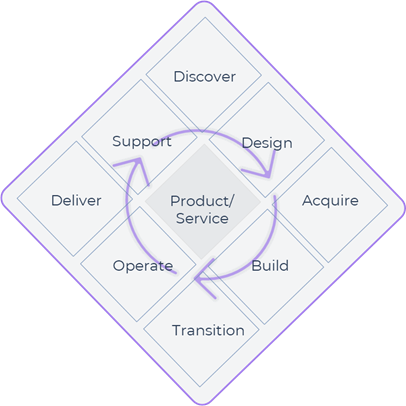
Six out of the eight stages should be applied to digital products and services, and ignoring one of these two aspects almost inevitably results in a misalignment between the intended and experienced value for the consumers.
From the lifecycle to a value chain
To manage digital products and services, organisations develop respective management capabilities. For example, to design products and services, we need to have relevant knowledge, skills, tools, and so on. The eight lifecycle stages can be translated into eight value chain activities, each supported by multiple management practices: to do product and service design, the organisation might need such practices as business analysis, availability management, risk management, and others.
The lifecycle model is useful as a representation of the product and service statuses, but it does not work as a model of the organisation’s activities:
- All eight activities may be performed at the same time, applied to different products and services, and to different versions of the same product and service.
- Not every organisation performs all eight activities; many decide to delegate some of these activities to other organisations.
In line with the proposed definitions of digital products and services, organisations may adopt the roles of product vendor, service provider, and service consumer.
- Product vendors are responsible for the creation and continual improvement of digital products;
- Service providers are responsible for the delivery and support of digital services;
- Service consumers are responsible for the procurement and use of digital services.
Some organisations (and teams) combine the roles of digital product vendor and service provider; others prefer to focus on one of these roles. Those who prefer to act only as a service provider or a product vendor should nevertheless consider both perspectives when they perform management activities. They should also know who is responsible for the product and service lifecycle stages outside their control, and how this impacts the quality and experience of the customers and users.
Value chain activities may be performed in different combinations, depending on the product and service they are applied to and on the organisation’s context. Combinations of these activities form the organisation’s value streams.
Summary and practical recommendations
Focus on value, think and work holistically. ‘Digital product’ and ‘digital services’ are two perspectives of one solution. They have a shared lifecycle and should be managed as one.
Organisations may decide to take responsibility for all or some of the digital product and service lifecycle stages. In the latter case, it is important to understand who is responsible for the rest of the lifecycle and to establish appropriate relationships with those parties. Collaborate and promote visibility.
Start where you are. Today, some organisations may have isolated ‘product’ and ‘service’ teams who do not collaborate well. The first step is to recognise that they manage different aspects of the same solutions, and to discuss the current distribution of responsibilities. Product and service tribes have more in common than they might think. Progress iteratively with feedback.
Keep it simple and practical. Integration of digital product and service management does not need complicated tools or new processes. It is based on a shared view of the solution lifecycle and a shared understanding of the intended and realised value for service consumers and other stakeholders.
Optimise and automate. Once the responsibilities for each stage of the product and service lifecycle are clear, use value stream mapping to understand and optimise the flow of work, information, and artifacts. When optimising, consider automation opportunities.

Roman Zhuravlev
Roman is ITIL Senior Architect at PeopleCert and a popular speaker, author and trainer.