

Claire Burn reflects on two days very well spent at our flagship event.
Conference fatigue is a real thing. So many events look great on paper — big‑name speakers, interesting topics, packed agendas — yet somehow, they manage to fall short on the day, leaving you slightly disappointed, as it never quite hit the mark you were hoping for. After a few of these, it’s easy to slip into the ‘why bother?’ mindset and decide the next conference probably isn’t worth the time out of the office.
Now, to all conference organisers out there who may be reading this thinking what a cheeky so and so, I want to recognise that arranging conferences is really hard. The teams work tirelessly securing venues, arranging speakers and hoping on the day that someone hasn’t double booked and the microphones all work. Yet in a market saturated with such events, your conference has to bring value… and in my view, not all of them do.
I first attended an itSMF Conference in 2009, presenting on “Service Management and the Youth of Today”, which reflected on the routes into Service Management for people leaving education and starting their careers. I asked where further and higher education could play a part in promoting ITSM within technology curriculums (the irony that it has taken a further 15 years for me to finally succeed in getting an ITSM module added to a Higher Education BA isn’t lost on me!). As reflected in Rhys Elis Jones’s recent blog, he “didn’t choose a career in service management; [he] just landed in it, completely by accident”. I now wonder if my presentation message to embed ITSM at the school stages and beyond didn’t land as well as I thought!
ITSM 2009 was a much smaller affair than you see today at conferences; lots of effort and organisation, but fewer speakers, fewer vendors and not as many pairs of socks up for grabs. Yet it was successful, engaging and certainly to my 2009 self, gave me lots to think about and helped focus my service management aligned future career.
Fast forward to 2025. I’m standing on a cold and windy train platform on a Sunday afternoon in November, waiting for a train to Milton Keynes which will undoubtedly be late, packed and too hot. I’m on my way to ITSM25 wondering if this, my first face to face itSMF UK Conference post-COVID, is really going to be worth it. Three days out of the office, which may be heaven to many, is to me a recipe for lots of emails to catch up on, umpteen meetings to rearrange, and a stack of extra work to do after I get back.
On the morning of the Conference I head to the opening event, full of trepidation about what I might find, wondering if I’ll know anyone (I’m attending alone) yet curious to see if this Conference will be the one that engages or disappoints. Here are my five key takeaways.
- The welcome
From the moment I met the itSMF UK team at the Conference reception, where they handed me all the equipment I’d need for the next two days with a smile, answered my (many) questions and sent me off to the main hall for the opening ceremony, I relaxed. Delegates, vendors, the events team and presenters were all welcoming and there was a real buzz about the event. All of us were there as we were interested in ITSM, we all wanted this to be a successful Conference, and we all wanted to learn. Thoughtful gestures such as the Quiet Room if you just needed to escape the hubbub and the pause for 2 minutes’ silence at 11am on 11th November made this Conference feel inclusive and considered.
- The diversity
This Conference differed from others I’d been to for the sheer breadth and depth of delegates and presenters. Many of the itSMF worldwide chapters were represented, meaning discussions took on a whole new perspective. Where else could you discuss why the Giant from Poland buried four people up to their necks in sand as an analogy for Design Thinking in ITSM, or take part in a ITIL quiz to win a Tam Tam? The breadth of knowledge in the rooms was palpable. Experienced colleagues provided guidance and wisdom from through the ITIL ages, while those colleagues just starting out brought a fresh look at ITSM, challenging us all to think about value in terms of people and technologies as they are now, not as they once were.
- The stretch
Four streams of presentations, over two days, covering 52 topics. My need for intellectual stimulation went into overdrive. I poured over the agenda in hyperfocus, wondering where should I go next? Attending one session sparked a thought explosion, so I changed my mind about the next session I would go to. As the Conference is super flexible and all sessions are recorded, I could change my mind at the last minute, knowing I’d be able to listen back to the other session at a later time. All thoughts of emails back in the office disappeared as I relished the chance to use a few dusty brain cells, speak to delegates and presenters about topics that I’d not thought about in a while, and also learn new knowledge (humanising IT or yoga breathing anyone?)
- The community
As someone who is happy in her own company, it turns out I’d missed my people. There is nothing as good for your mental health as being with those who think like you, are interested in the same goals and in an environment where you are encouraged to think, challenge and not be afraid to have an opinion. I’m sure we all have those days where you feel unable to authentically share your ideas, passions or intellect and this Conference made me really appreciate the ITSM community and what a fantastic support network they are.
There were plenty of positive encouragements from the presenters to ask questions, share opinions, and question what they had shared, and the level of respect for the views of others was uplifting. As a solo delegate I never felt like I was standing on the sidelines. I made new friends, chatted to lots of like-minded people and yet could also just sit and absorb the event if I preferred.
- The awards
ITSM is often seen as ‘process for process’ sake’, a sea of reporting and frameworks all designed to stop IT folk from developing, releasing and changing systems and services any time they’d like. This of course isn’t the case and we all know that used correctly, ITSM is supportive, drives innovation and encourages change in a safe, governed and planned way, focussing on value. The Professional Service Management Awards offer a fantastic opportunity to showcase this and I sat and listened to stories of transformation, where technology and ITSM had delivered real impactful change across a variety of organisations and sectors worldwide.
The pride our community demonstrated in one another, in the work that we do and the joy with which the winners reacted, made this the best awards ceremony I’ve been too. To see people I’ve known or worked with for many years recognised for lifetime achievements (still delighted for you, Claire Agutter) and to see our Young Professionals category celebrating such potential (well done again, Chloe Mackay) was quite frankly, emotional.
Two days later, on the train home, I sat and reflected on the Conference. Had it proved valuable to me – absolutely. It had woken my mind from a slumber and started me thinking again. Had I enjoyed it – yes. Despite being a grumpy middle aged woman worn down by 35 years of work, I had quite simply had a ball and enjoyed every session I attended, every chat I had, and was pleased I met the people that I did. Would I go again – 100%. I have been missing out by not being at this Conference on many levels, personal and professional.
Finally, the big one, will I be booking again for ITSM26? A resounding yes. If what I’ve written doesn’t inspire you to come along and give it a try, then maybe the lure of ITIL socks will do it. Conference fatigue may be real, but it turns out, the cure might just be ITSM26.
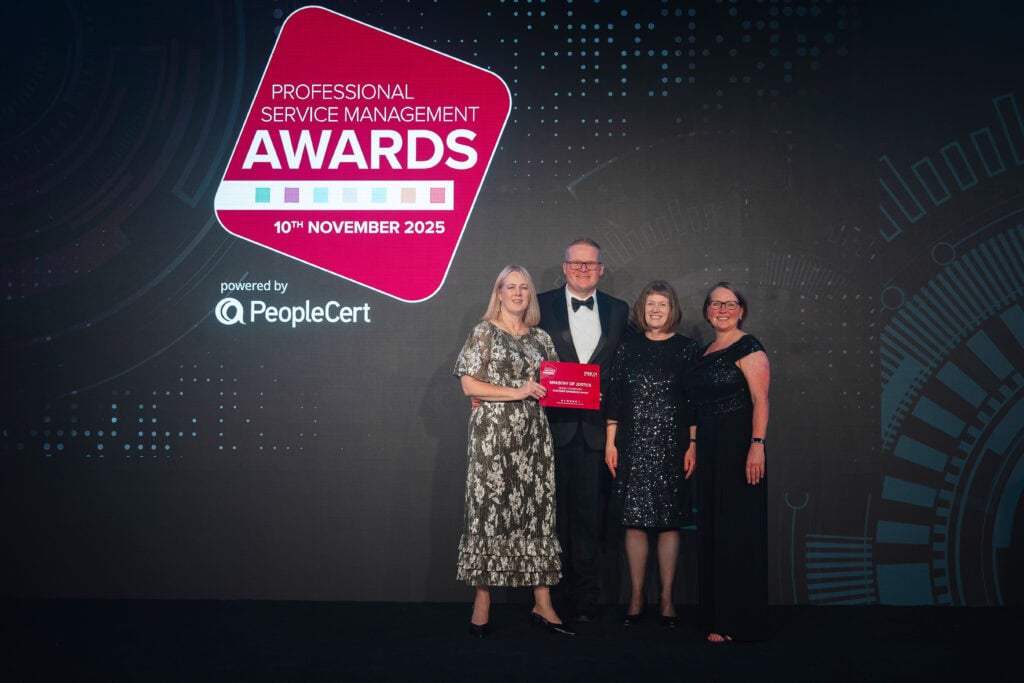
Claire Burn (right) celebrating with the MoJ team at ITSM25.

Claire Burn
Claire Burn is Assistant Director - IT Service Delivery at Northumbria University.