

Simon Rolley offers his key takeaways from ITSM25, itSMF UK’s 2025 Annual Conference
I joined 30 of my own colleagues and hundreds of service management professionals at ITSM25, two days of learning, networking, and exploring what’s next for our community. From leadership lessons inspired by espionage to the future of AI, here are seven key takeaways that stood out from this year’s annual conference. I’ve tried to make it short and snappy to hold your attention, but believe me, there was so much more I could have said and I encourage you to attend next year if you have the opportunity.
DAY ONE VIDEO: https://youtu.be/8xuxxPcNwzw
AI was a running theme throughout the conference, and it gave me an idea to generate a small video for every session. I used my own device and Grok to create these from still images. Hopefully you will enjoy these and they whet your appetite to read on and learn more about what the conference offers.
DAY TWO VIDEO: https://youtu.be/yjMoESuOAmM
1. Welcome to the future (Claire Drake, Fujitsu)
itSMF UK Chair Claire Drake opened with a clear message: the pace of change in ITSM is accelerating. Topics ranged from AI and automation to quantum computing, spatial computing, IoT, edge computing, blockchain, and cybersecurity. These aren’t distant concepts—they’re shaping service delivery today. The boundaries between ITSM and ITOM are blurring, and knowledge management is evolving with AI-powered tools.
Takeaway: Organisations must embrace emerging technologies and adapt quickly to stay relevant and deliver value.
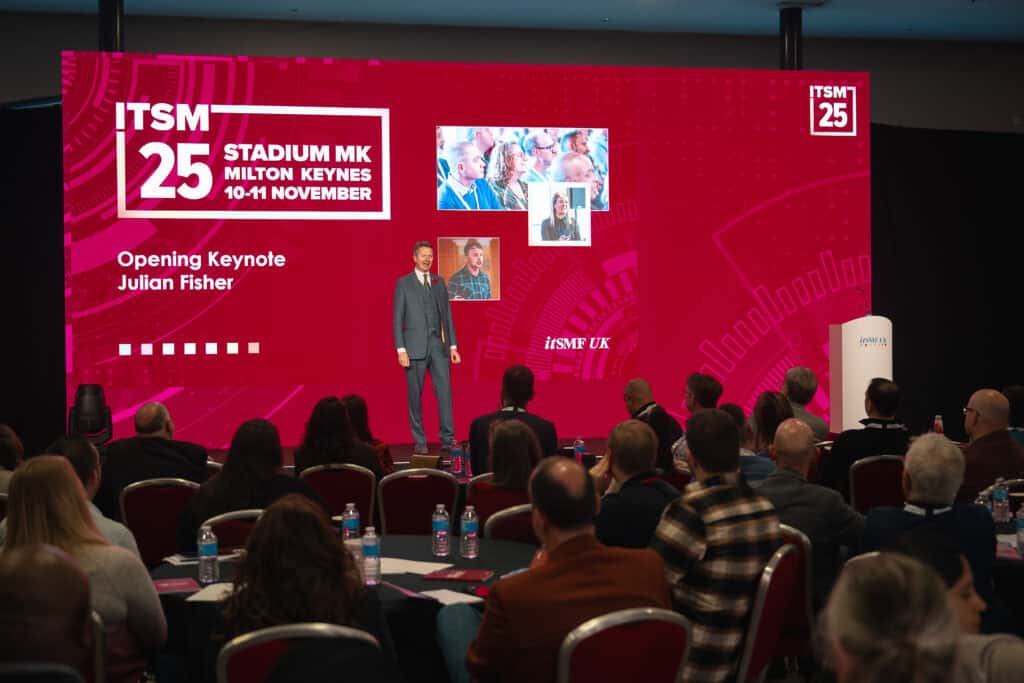
2. Lead like a spy (Julian Fisher, keynote)
Julian Fisher shared leadership principles drawn from his experience in intelligence. His advice:
- Put yourself second
- Show vulnerability
- Occupy common ground.
He illustrated how trust and human connection can turn high-risk situations into collaboration—skills that apply equally in business leadership.
Takeaway: Effective leadership is built on trust, empathy, and influence—not authority alone.
3. Frameworks: the foundation of resilience (Gary Mulqueen, MoD)
Gary Mulqueen highlighted the importance of a unified service management framework as a standard. When teams work to different standards, resilience suffers. His solution: one agreed framework, clear language, and practical processes. This approach helped the Ministry of Defence streamline continuity planning and reduce complexity.
Takeaway: A consistent framework underpins operational resilience and ensures continuity during disruption.
4. What pilots can teach us about major incidents (Nigel Murphy, Fujitsu)
Nigel Murphy took us on a flight (figuratively) through the world of air traffic control. Pilots rehearse emergencies like their lives depend on it—because they do. His point? IT teams should do the same.
He showed us how aviation uses checklists, simulations, and a common lexicon to handle chaos. Even Sully’s famous Hudson River landing relied on a checklist—though creativity saved the day when both engines failed (because no one rehearses ‘birds take out both engines’).
Takeaway: Regular rehearsals and clear communication protocols are essential for effective incident management. And mock-up rehearsals are a safe place to fail and improve the drills.
5. Shadow AI: the sneaky risk you didn’t see coming (Akshay Anand & James Finister)
Shadow AI is like Shadow IT’s cooler, more dangerous cousin. Employees are using AI tools without telling anyone, and the risks are huge—think data leaks, compliance nightmares, and maybe even jail time.
Why do people do it? Because the free tools are sometimes better than the ones at work. (Ouch.) Akshay and James reminded us that this isn’t new—we panicked over sharing data with telephones, cameras, and WhatsApp once too. The difference now? AI can process sensitive data faster than you can say ‘GDPR breach.’
Some organisations aren’t sanctioning use of any AI and this is where the largest risk of Shadow AI exists.
Takeaway: Organisations should strengthen governance, provide secure AI solutions, and educate teams on responsible use.
6. Neuroscience: why your brain hates change (Hannah Holden)
Hannah Holden dropped a truth bomb: 70% of digital transformations fail because biology beats strategy. When stressed, your brain basically goes on strike. The amygdala screams ‘danger,’ and your prefrontal cortex—the part that handles logic and creativity—packs up and leaves.
Her fix? Techniques to calm the nervous system—like breathing exercises and interoception. She even got the whole room talking for three minutes straight, and suddenly everyone looked… less stressed. It was a reminder that transformation isn’t just about tech—it’s about people. And people need calm brains to adopt change. She provides a free guide too on her website – Hannah Holden: The Burnout Alchemist ✨
Takeaway: Change isn’t scary—it’s just your amygdala being dramatic. Breathe, talk, and maybe bookmark Hannah’s guide. Your next project might depend on it.
7. One AI agent to rule them all (Jaro Tomik, CDW UK)
Jaro Tomik walked on stage dressed like a wizard. Yes, really. His talk on Agentic AI was part tech forecast, part comedy show, and entirely memorable.
The gist? We’re moving from chatbots to autonomous agents that fix problems before they happen. His prediction: full-blown Agentic AI by 2030. He also introduced ‘vibe coding’—building apps with natural language. Basically, tell the AI what you want, and it does the coding.
Takeaway: Start exploring how AI-driven automation can enhance efficiency and free teams to deliver greater value.
Closing thoughts
There is so much more I could tell you about this event, I havent even mentioned the vendors who are all on stands ready to talk to you about their latest developments and capabilities, and the opportunity to network with your own people as well as everyone else from so many other organisations.
Two fantastic days, many big ideas, and countless conversations later, one thing is clear: ITSM isn’t just about technology—it’s about people, resilience, and the courage to embrace change. It was a great chance to learn, laugh, and look ahead together. The future might be complex, but with the right mindset (and maybe a wizard’s hat), we’re ready for it.

Simon Rolley
Simon Rolley is DIgital Recruitment Lead for ITSM at DWP Digital Group.